
📖 Journey Inside the Atom
Expand each topic below and explore the fascinating journey inside the atom, one concept at a time.
Everything in the universe that has mass and occupies space (volume) is called matter. Air, water, plants, animals, rocks, and even our own body are all made of matter.
The smallest building block of matter is called an atom. Atoms are extremely tiny particles that combine to form all substances around us. Although atoms are too small to be seen with the naked eye, they are the basic units from which every element and compound is made.
The idea of the atom is not new. Around 2000 years ago, ancient Indian philosophers described the smallest indivisible particle of matter as "Parmanu" in Sanskrit texts. Around the same time, the Greek philosopher Democritus used the word "Atomos", meaning "indivisible".
In 1808, the English scientist John Dalton proposed the modern Atomic Theory. According to Dalton, all matter is made up of extremely small, indivisible particles called atoms. His theory laid the foundation of modern atomic science.
Definition
Atom: The smallest particle of an element that retains all the chemical properties of that element.
After John Dalton proposed his Atomic Theory in 1808, scientists believed that an atom was the smallest and indivisible particle of matter. According to Dalton, atoms could not be divided into smaller parts.
🤔 Think About It
If an atom is indivisible, how can scientists study what is inside it?
For many years, scientists accepted Dalton's idea. However, towards the end of the 19th century, two important discoveries completely changed this belief.
1. Discovery of Radioactivity
Scientists discovered that some elements, such as uranium, naturally emitted invisible rays. This phenomenon was called radioactivity.
If atoms were truly indivisible, they should have remained unchanged. But the emission of these rays suggested that something was happening inside the atom.
2. J. J. Thomson's Cathode Ray Experiment
Around the same time, the English scientist J. J. Thomson performed the famous Cathode Ray Experiment. His experiment led to the discovery of the electron, the first subatomic particle.
This proved that atoms were not indivisible. Instead, they contained smaller particles within them.
Conclusion
These discoveries completely changed the scientific understanding of the atom. Scientists realized that atoms have an internal structure, marking the beginning of the fascinating journey inside the atom.
Key Concept
The discovery of radioactivity and the electron proved that atoms are made up of smaller particles. These smaller particles are called subatomic particles.
The discovery of subatomic particles completely changed our understanding of the atom. Scientists proved that atoms are not indivisible but are made up of smaller particles called subatomic particles. The three fundamental subatomic particles are the electron, proton and neutron.
🤔 Think About It
If atoms contain smaller particles, how did scientists discover these tiny particles that cannot be seen?
1. Discovery of Electron – J. J. Thomson (1897)
In 1897, the English scientist J. J. Thomson studied the conduction of electricity through gases at a very low pressure. He used a glass discharge tube fitted with two electrodes—a cathode (−) and an anode (+).
When a very high voltage was applied across the electrodes, a beam of invisible rays travelled from the cathode towards the anode. These rays were called cathode rays.
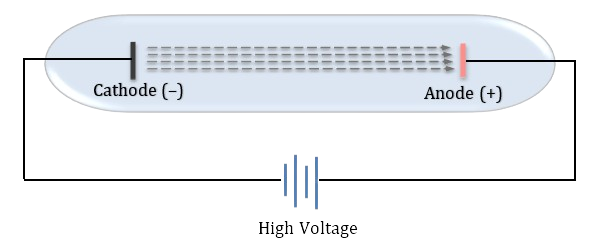
J. J. Thomson's Cathode Ray Experiment (1897)
Observations
- Cathode rays travelled from the cathode towards the anode.
- They were deflected towards the positive plate, showing that they carried a negative charge.
- The nature of cathode rays was the same irrespective of the gas taken inside the tube.
- The rays were also independent of the material used for the cathode.
Conclusion
J. J. Thomson concluded that cathode rays are streams of tiny negatively charged particles called electrons. Since every atom produced these particles, electrons are present in all atoms.
Important Fact
The charge of an electron is −1.602 × 10⁻¹⁹ C. For convenience, its relative charge is taken as −1.
🌟 Curiosity Fact
J. J. Thomson received the Nobel Prize in Physics in 1906 for his investigations on the conduction of electricity by gases and his discovery of the electron.
Interestingly, science continued in his family. His son, George Paget Thomson, also received the Nobel Prize in Physics in 1937 for proving the wave nature of electrons.
Thus, a father and son both became Nobel Prize winners for their important contributions related to electrons.
2. Discovery of Proton – Anode Rays / Canal Rays (Goldstein, Rutherford)
After the discovery of electrons, scientists wondered whether atoms also contained positively charged particles.
In 1886, Eugen Goldstein modified the discharge tube by using a perforated cathode (a cathode having tiny holes). During the experiment, he observed another type of rays moving in the opposite direction. These rays passed through the holes in the cathode and were called canal rays or anode rays.

Goldstein's Canal Ray (Anode Ray) Experiment
Observations
- Canal rays travelled from the anode towards the cathode.
- They carried a positive charge.
- Their properties depended on the gas present inside the tube.
- They were much heavier than electrons.
Conclusion
Goldstein's experiment proved the existence of positively charged particles in atoms. Later, Ernest Rutherford identified these particles as protons.
3. Discovery of Neutron – James Chadwick (1932)
Although electrons and protons had been discovered, scientists could not explain the total mass of the atom.
In 1932, the English physicist James Chadwick discovered a new particle called the neutron.
Neutrons have no electric charge and their mass is almost equal to that of a proton. They are present inside the nucleus of the atom along with protons.
Key Concept
The discovery of the electron, proton and neutron proved that atoms are made up of three fundamental subatomic particles.
| Particle | Scientist | Charge | Location |
|---|---|---|---|
| Electron | J. J. Thomson | −1 | Outside the nucleus (Shells) |
| Proton | Ernest Rutherford* | +1 | Nucleus |
| Neutron | James Chadwick | 0 | Nucleus |
*Goldstein discovered positive (canal) rays, while Rutherford later identified the proton as a fundamental particle.
🤔 Think About It
If an atom contains positively charged protons, negatively charged electrons and neutral neutrons, how are these particles arranged inside the atom?
To answer this question, scientists proposed different atomic models. Each new model tried to explain the structure of the atom more accurately than the previous one.
1. Thomson's Model of Atom (1904)
After J. J. Thomson discovered the negatively charged electron, he faced an important question: atoms are electrically neutral, so where is the positive charge present?
To explain this, Thomson proposed that an atom is a sphere of positive charge in which electrons are embedded throughout the atom.
This model is commonly known as the Plum Pudding Model.
🍉 Easy Way to Understand
Imagine a watermelon. The red pulp represents the positively charged part of the atom, while the seeds represent the negatively charged electrons distributed throughout it.
Main Features of Thomson's Model
- The atom is a sphere of positive charge.
- Electrons are embedded throughout the positively charged sphere.
- The positive and negative charges balance each other, making the atom electrically neutral.
- There is no separate nucleus in Thomson's model.
Limitation
Thomson's model could not explain the results of Rutherford's α-particle scattering experiment. Therefore, a new model of the atom was needed.
2. Rutherford's Nuclear Model of Atom (1911)
Ernest Rutherford proposed the nuclear model of the atom based on the results of his famous α-particle scattering experiment.
α-Particle Scattering Experiment
Rutherford directed a beam of high-energy α-particles, which are positively charged, towards a very thin sheet of gold foil.
A fluorescent screen was placed around the gold foil to detect the paths of the α-particles after they passed through or were deflected by the foil.

Rutherford's α-Particle Scattering Experiment
Observations
- About 99.9% of α-particles passed straight through the gold foil without any deflection.
- A small number of α-particles were deflected through small angles.
- A very small number of α-particles were deflected backwards or rebounded.
Conclusions
- Most of the atom is empty space.
Since most α-particles passed straight through the foil, most of the space inside an atom must be empty. - There is a small positively charged nucleus.
The deflection of some α-particles showed that positive charge is concentrated in a very small region at the centre of the atom. - The nucleus is very small and dense.
The few α-particles that bounced back showed that the nucleus is extremely small, dense and contains almost all the mass of the atom.
Main Features of Rutherford's Model
1. Nuclear Region
The atom has a very small, dense region at its centre called the nucleus. It contains the positive charge and almost all the mass of the atom.
2. Extranuclear Region
Most of the atom is empty space. Electrons revolve around the nucleus in this region. This arrangement was compared with planets revolving around the Sun, so Rutherford's model is also called the Planetary Model.
⚠️ Drawbacks of Rutherford's Model
1. Stability of Atom: According to classical physics, a revolving electron should continuously lose energy. It would eventually spiral towards the nucleus. However, atoms are actually stable.
2. Arrangement of Electrons: Rutherford's model did not explain how electrons are arranged around the nucleus or why electrons occupy particular regions around it.
3. Atomic Mass: At the time, the neutron had not yet been discovered. Therefore, Rutherford's model could not explain the complete mass of an atom.
3. Bohr's Model of the Atom (1913)
Rutherford's model successfully explained the presence of the nucleus and showed that most of the atom is empty space. However, it could not explain the stability of the atom.
To overcome this problem, Danish physicist Niels Bohr proposed a new model of the atom in 1913.
🤔 Think About It
If electrons are moving around the nucleus, why don't they lose energy and fall into the nucleus?
Main Postulates of Bohr's Model
1. Fixed Circular Paths
Electrons do not move randomly around the nucleus. They revolve only in certain fixed circular paths called orbits, shells, energy levels or stationary states. Each shell has a definite amount of energy.
2. Representation of Energy Levels
The shells are represented by the letters: K, L, M, N, ...
They are also represented by numbers: n = 1, 2, 3, 4, ...
📌 Energy Level Order
The shell closest to the nucleus has the lowest energy. The energy increases as we move away from the nucleus.
K < L < M < N
3. No Energy Loss in a Fixed Shell
Electrons can move only in the allowed fixed shells. While revolving in a fixed shell, an electron does not lose energy. This explains the stability of atoms.
4. Movement of Electrons Between Shells
An electron can move from one energy level to another by absorbing or releasing a definite amount of energy.
⚡ Electron Transition
Absorption of energy → Electron moves to a higher energy level.
Release of energy → Electron moves to a lower energy level.
The energy absorbed or released is equal to the difference between the energies of the two shells.
5. Electron Capacity of Shells
Each shell can accommodate only a certain maximum number of electrons. The maximum number of electrons that can be accommodated in a shell is given by:
Maximum number of electrons = 2n²
Here, n is the shell number.
📊 Electron Capacity of Shells
| Shell | n | 2n² | Maximum Electrons |
|---|---|---|---|
| K | 1 | 2 × 1² | 2 |
| L | 2 | 2 × 2² | 8 |
| M | 3 | 2 × 3² | 18 |
| N | 4 | 2 × 4² | 32 |
How Does Bohr's Model Explain the Stability of Atom?
According to Rutherford's model, an electron revolving around the nucleus should continuously lose energy and eventually fall into the nucleus. This would make the atom unstable.
Bohr introduced the idea of stationary states. Electrons in these permitted energy levels have definite energy and do not lose energy while remaining in the same shell.
⭐ Key Idea
Electrons in fixed energy levels do not continuously lose energy. Therefore, the atom remains stable.
🌟 Remember
Thomson → Positive sphere + electrons embedded in it
Rutherford → Tiny positive nucleus + mostly empty space + electrons around the nucleus
Bohr → Electrons occupy fixed energy levels or shells and do not lose energy while remaining in the same shell
Chapter Summary
In this chapter, we learned about the internal structure of atoms, the discovery of subatomic particles, different atomic models, and the arrangement of electrons. We also understood important concepts like atomic number, mass number, valency, isotopes, and isobars.
Mind Map
Important Questions
- What are subatomic particles? Name them.
- Explain the different models of atoms.
- Define atomic number and mass number.
- What are isotopes and isobars?